
Books
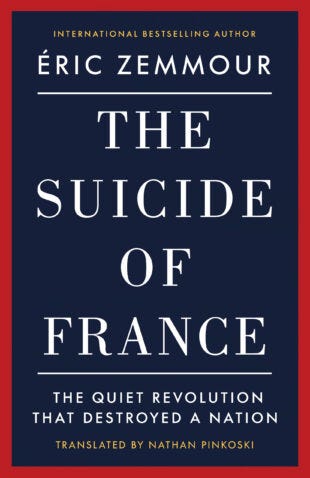
The Suicide of France
Introduction and Translation by me. You can order here.
After Charles de Gaulle’s death in 1970, France’s new leaders launched a quiet revolution. Under the guise of guiding the country into a new progressive era, they destroyed everything that had made it great. Éric Zemmour’s The Suicide of France pulls back the veil on their project, showing the contempt France’s new leaders had for her culture, heritage, and institutions.
These new leaders destroyed the strong presidential republican system that de Gaulle had built, replacing it with the government of activist judges. They attacked the authority of the father figure, replacing him with the hollow, feminized man of managerial society. And despite their constant expressions of disdain for the United States, they imported the worst of its post-60s multicultural and economic revolutions into France to replace her people and ways. Step-by-step, episode-by-episode, Zemmour describes the devious stratagems and devices that eroded the soul of a once-great nation.
Released in 2014, The Suicide of France became a runaway bestseller, turning its author into one of the most famous—and infamous—writers and political figures in France. Now available for the first time in English, this edition includes a new introduction and conclusion. Zemmour reflects on what has happened in France over the past decade. He recounts why he jumped from writer to politician, running for president of France in 2022 and founding a new political party, Reconquête!. Finally, he reflects on the precarious situation of France and the United States today as they struggle to preserve their shared civilization.
*
The Suicide of France is a work of thrilling prose and high intellectual ambition. Already it can be called a classic. As Paul Johnson did in Modern Times, Zemmour takes the events of the last half-century, long shrouded in progressive clichés, and places them in a more logical relationship: “We were taught to love what we used to hate,” he writes, “and to hate what we used to love.”
— Christopher Caldwell, author of The Age of Entitlement: America Since the Sixties
Zemmour is that rare type of public intellectual who combines erudition, patriotism, and spiritedness. With unsparing clarity, he vividly retells the story of how the French ruling class destroyed the country he loves through Muslim immigration, feminist ideology, and transnationalism. This is essential reading for understanding France’s crisis, as well as the broader post-sixties decline of the West.
— David Azerrad, Hillsdale College
The Suicide of France is the best single book that has been written about what has happened to France since 1968. An invaluable resource for understanding contemporary France. A highly readable set of vignettes. The new translation by Nathan Pinkoski is excellent and faithful to the original.
— Pascal-Emmanuel Gobry, Founder and CEO of Sphere Media
Zemmour’s The Suicide of France offers a Copernican turn. What if the “Derision, Deconstruction, and Destruction” extolled by the progressive intellectual and political elites was to be deconstructed? Over a decade after its original publication, this book’s attack on the dogmas that shape the French political landscape is more than ever a key to understand what went wrong in France and in the Western world.
— Marie Kawthar Daouda, author of Not Your Victim: How Our Obsession with Race Entraps and Divides Us
If you want to understand the revolution that engulfed the West over the last half century, this is the book to read. Zemmour shows how developments on the financial, political, and sexual fronts combine to dispossess us of a stable and meaningful world. He also shows that the ever-more militant inversions of reality demanded by the powerful come down to daddy issues: hatred of the figure of the father.
— Matthew B. Crawford, senior fellow at the University of Virginia’s Institute for Advanced Studies in Culture

The Camp of the Saints
Introduction by me. You can order here.
A migrant fleet, a million strong, sets sail from Calcutta. Its destination: Europe. As the fleet advances, the continent is submerged by a torrent of words. Will the old nations of Europe resist the migrants or welcome them? Honor their past or embrace the radiant future? Open fire or open their hearts?
Enthusiasm, delusion, cowardice. And, finally, panic. The migrants make landfall...
First published in 1973, Jean Raspail’s The Camp of the Saints ranks among the great dystopian novels of the twentieth century. Long out of print in translation, it is often hailed as prophesizing the mass migrations of our own day. The present edition contains an introduction by the scholar of French political thought Nathan Pinkoski, the 2011 preface that Raspail wrote by way of final testament for the book, and an original translation by Ethan Rundell.
For the first time available in English after years of neglect, this edition will allow a new generation of readers to pose Raspail’s questions for themselves and measure the distance we have come - or not come - since the book was first published over fifty years ago.
*
“This book by Jean Raspail is the ever-fresh story of Cassandra. Before anyone else, Raspail foresaw the ‘Great Replacement’ of Europe’s peoples by their counterparts from the Global South. Before anyone else, he understood that what was called immigration was in fact invasion. He said it, wrote it, foretold it. But Cassandra is never believed.” — Éric Zemmour
“The Camp of the Saints is not really about migrants; it’s about us, and whether we peoples of the West, long paralyzed by the sentimental humanitarianism and civilizational self-hatred of a spiritually corrupt elite, still have the power to rewrite this tragic story.” - Rod Dreher, The European Conservative
“The Camp of the Saints remains closely, horribly relevant to our dilemmas right now. This new translation could not be more timely, more fraught.” - David Sexton, The Times of London
“The Camp of the Saints does not flatter; it does not console. It strips away illusions and forces us to see how quickly a civilization can collapse when it forgets to defend itself.” - Peter Gietl, The Blaze
“In the end, the work is not so much a polemic as an extended interrogation or question. It challenges the reader to imagine a West that would not only be able to halt such an invasion but also one that would be actively worthy of saving.” - Adam Van Buskirk, Washington Examiner
“The Camp of the Saints is not a novel about the West against the Rest. It’s a story about civil war within the West.” - R.R. Reno, First Things
“In the same way that The Handmaid’s Tale looms over abortion politics, or The Terminator lurks over artificial intelligence, The Camp of the Saints hangs over immigration politics.” - Idrees Kahloon, The Atlantic

Alasdair MacIntyre: An Intellectual Biography
Translation by me. You can order here.
This award-winning biography, now available for the first time in English, presents an illuminating introduction to Alasdair MacIntyre and locates his thinking in the intellectual milieu of twentieth-century philosophy.
Winner of the prestigious 2005 Philippe Habert Prize, the late Émile Perreau-Saussine’s Alasdair MacIntyre: Une biographie intellectuelle stands as a definitive introduction to the life and work of one of today’s leading moral philosophers. With Nathan J. Pinkoski’s translation, this long-awaited, critical examination of MacIntyre’s thought is now available to English readers for the first time, including a foreword by renowned philosopher Pierre Manent.
*
“Émile Perreau-Saussine has produced an interesting and provocative interpretation of Alasdair MacIntyre and Nathan Pinkoski’s translation has provided the English-speaking world access to the work....Any university library with a serious politics, philosophy, or theology program should procure a copy.” ―The American Journal of Jurisprudence
“In this book, Perreau-Saussine traces the complex intellectual development of Scottish American philosopher Alasdair MacIntyre (b. 1924) with a view to showing the underlying unity of his life’s work. ...Recommended.” ―Choice
“The real value of Perreau-Saussine’s biography lies less in its exposition of MacIntyre’s intellectual development than in its extended clarification of what is at stake in the questions MacIntyre explores. . . . For Perreau-Saussine, political progress will come when we better navigate these tensions within the liberal order, not when we seek to resolve them entirely outside it. Whether his eminent case proves his point is worth our careful reflection.” ―The Hedgehog Review
“Alasdair MacIntyre: An Intellectual Biography, by the philosopher Émile Perreau-Saussine, is less an academic study than an essay on MacIntyrean themes. . . It’s engaging and accessible.” ―The Nation
“[F]or those who would like to consider the merits and demerits of liberal democracy in a judicious way, Émile Perreau-Saussine’s critical study of one of antiliberalism’s éminence grise is now available. It is both a specimen and a model of the sort of political philosophizing sorely needed in our trying times.” ―Law & Liberty
“Perreau-Saussine makes a valuable contribution for those looking to understand the context and nature of Alasdair MacIntyre’s thought. He strikes a balance by pulling together biographical details, intellectual influences, and a variety of publications to craft a portrait of one of the twentieth century’s most influential philosophers.” ―The University Bookman
“On the whole, this is a[n] . . . insightful essay in intellectual history. Or rather, it is three essays, dealing respectively with MacIntyre’s politics, philosophy, and theology. The first covers MacIntyre’s early involvement with the British New Left. . . . A second chapter deals with the philosophy of action and ethics. . . . A last chapter, on theology, sees Perreau-Saussine return to safer ground.” ―First Things
“Alasdair MacIntyre is a moral philosopher of the first rank. . . . May our contemporaries be receptive to the wisdom and moderation that informs this splendid and timely book.” ―Claremont Review of Books
“Alasdair MacIntyre: An Intellectual Biography by Émile Perreau-Saussine seeks to defend the Scottish philosopher’s standing as one of the most profound theorists of capitalist modernity on either side of the Atlantic. . . . [A]long the way we do learn a great deal about MacIntyre’s life and how it informed his unique blend of Marxist-Catholic Scholasticism.” ―Jacobin
“MacIntyre stands in the modern intellectual landscape as one of tradition’s great champions, but he was never a particularly happy warrior, even though he had a great deal to say about what makes men happy. Anyone who is intrigued by these puzzles will find this book of considerable interest.” ―Law & Liberty
“[The book’s] treatment of MacIntyre’s religious struggles and his journey to the Catholic Church is perhaps its strongest part and will be a revelation to anyone accustomed to a more narrowly philosophical approach to MacIntyre’s ideas.” ―Current
“Provides a penetrating overview of the ideas of 20th-century moral philosopher Alasdair MacIntyre. . . . Perreau-Saussine proves a talented historian of ideas, cogently elucidating how such diverse traditions as Marxism, Catholicism, and Aristotelianism come together in MacIntyre’s writings.” ―Publishers Weekly
“The book is a sympathetic treatment of the ideas that have consistently run through MacIntyre’s complicated career, but it doesn’t hesitate to pose to MacIntyre tough-minded intellectual challenges. It is a genuine philosophical dialogue between two serious thinkers.” ―Ronald Beiner, author of Dangerous Minds
“Alasdair MacIntyre is one of the most influential and widely read moral philosophers of the last three or four decades. This remarkably erudite and comprehensive book is an indispensable guide for anyone who has a serious interest in twentieth-century moral and political philosophy.” ―Richard Kraut, author of The Quality of Life
“The scholarship behind the book―the volume of Anglophone philosophy Perreau-Saussine had to absorb, inside and outside MacIntyre’s corpus―is hugely impressive. And we owe Pinkoski a debt for doing the unglamorous kind of work Perreau-Saussine himself did first.” ―Commonweal
“One of the most striking elements in the Foreword by Pierre Manet and throughout Perreau-Saussine’s subtle rendering of Alasdair MacIntyre’s intellectual contributions is the recognition that liberalism is deeply f lawed as a social-political ideology and yet at the same time, cannot be abandoned as a political framework because it allows for subjective ethical freedom.” ―Studies in Christian Ethics
Augustine in a Time of Crisis: Politics and Religion Contested
Co-edited by me. You can order here.
This volume addresses our global crisis by turning to Augustine, a master at integrating disciplines, philosophies, and human experiences in times of upheaval. It covers themes of selfhood, church and state, education, liberalism, realism, and 20th-century thinkers. The contributors enhance our understanding of Augustine’s thought by heightening awareness of his relevance to diverse political, ethical, and sociological questions. Bringing together Augustine and Gallicanism, civil religion, and Martin Luther King, Jr., this volume expands the boundaries of Augustine scholarship through a consideration of subjects at the heart of contemporary political theory.